
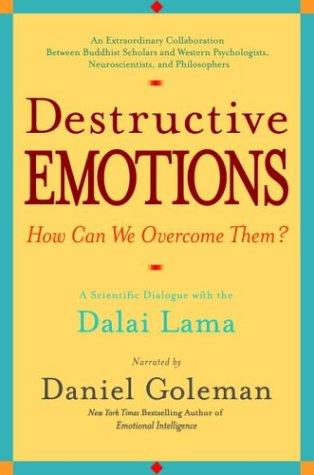
(this blog post is work in progress) In my eyes, Buddhism was always a philosophy (or religion if you want), that has so close to science and scientific approach as no other religion does. As Dalai Lama says in prologue to this book (freely rewritten):
"Science has become a primary force in human and planetary development. It has been responsible for great material progress. However, science does not have all the answers, nor religion does. We must balance scientific and material progress with the sense of responsibility that comes of inner development. Science is beneficial in many areas and Buddhism is welcoming to scientific achievements, because there is much to learn from. At the other hand, there are few areas in Buddhism from which also science can learn. One of the areas that the Buddhism is good at, is human problems presented by our destructive emotions. In fact, central aim of Buddhist practice is to reduce those emotions, since they are no longer needed in modern society and in almost all cases, no one benefits from destructive emotions. The scientists went a step beyond and have begun programs to test several Buddhist methods that may be of benefit to all in dealing with destructive emotions. "
This book is about discussion of many scientist and Dalai Lama among them, trying to understand where are the roots of destructive emotions and how to counter them. Barbarous acts against humanity are not going to stop any soon. Dalai Lama is special guest to this discussion, because "... his life itself is an object lesson in handling historical injustice". From scientific point of view:
"Destructive emotions are brain responses that shaped the human mind, and played a crucial role in human survival. In modern life, they are dangerous to our individual and collective fate. Are they still essential for human survival?"
A scientific collaboration Our story starts with an intriguing collaboration between a centuries old science of mind and cutting-ege neuroscience. The Lama in the Lab Scientists are about to research brain activities of highly trained Buddhist monk - lama Oser.
If destructive emotions mark one extreme in human proclivities, this research seeks to map their antipode, the extent to which the brain can be trained to dwell in a constructive range: contentment instead of craving, calm rather than agitation compassion in place of hatred.
Researchers proposed to monitor brain activities while lama is doing these types of meditation: visualization, one-pointed concentration and generating compassion. Lama then added three more types to look at: devotion, fearlessness and open state. Scientists had one day to test lama Oser with fMRI and EEG technology. From a scientific point of view, if Oser could demonstrate sharp, consistent brain signatures for any of these meditative states, it would be a first. And he did. When reviewing accumulated data at the next day, Richard Davidson, director of Laboratory for Affective Neuroscience at University of Wisconsin-Madison said to Dalai Lama:
I've seen His Holiness penetrate into the data when everyone else but the specialists are left behind.
Regarding fMRI, untrained subjects given a mental task are unable to focus exclusively on the task and consequently have considerable noise added to the signals that reflect their voluntary mental strategies. But for Oser, it seemed that his mental strategies were accompanied by strong, demonstrable shifts in the MRI signals. Shifts between signals from 6 tested meditative states were so clear, that they could be compared to shifts between waking to sleep in ordinary person's case. Results from EEG are no less interesting. Most striking was a dramatic increase in key electrical activity known as gamma in the left middle frontal gyrus. This is by Davidson's previous research a place in brain where positive emotions reside. When people have high levels of brain activity here, they report feelings such as happiness, joy high energy and alertness. At the other parallel side of the brain is a center for exactly opposite feelings - sadness, anxiety and worry. For example people with clinical depressions and anxiety disorder have more brain activity here. We each have a characteristic ratio of right-to-left activation in the prefrontal areas that offers a barometer of the moods we are likely to feel. That ratio is kind of emotional set point around which our daily moods swing. We are able to shift this ratio by any means, but these shifts are only modest. While Oser was generating a state of compassion during meditation, he showed remarkable positive shift, one that was extraordinarily unlikely to occur by chance alone. This confirms the observation often made by Dalai Lama, that:
The person doing a meditation on compassion for all beings is the immediate beneficiary
Another tests were performed at University of California in Human Interaction Laboratory by Paul Ekman. The first test used a videotape with series of human face expressions show only for a fraction of a second. Subject has to recognize what kind of expression it is. Both Oser and another advanced Western meditator were two standard deviations above the norm. They both scored higher than other five thousand people tested, included Secret Service agents, the group that was most accurate until then. So we can definitely say, that those advanced meditators are more aware of subtle signs of how other people feel. Next test on schedule was startle reflex. This kind of natural reaction of most animals including human, comes from most primitive part of our brain. Test subject will hear a huge sound (gunfire) and scientists measure it's reaction that involves muscle movement, heart beat and other symptoms. Every person tested so far, has this kind of reactions, no matter how hard he/she tries. Paul Ekman said to Dalai Lama at the next day:
When Oser tries to suppress the startle, it almost disappears. We've never found anyone who can do that. Nor have any other researchers. This is spectacular accomplishment. We don't have any idea of the anatomy that would allow him to suppress the startle reflex.
As Oser later explained, he was able to suppress startle with help of one-pointed and open state meditation techniques. Beside all the experiments, all participating scientists agreed, that during those few days of discussions and meetings with lamas, they were amazed how unusually concentrated and involved they were. Dalai lama explained, that meditation on concentration and one-pointedness is not a spiritual practice, it's simply a tool that anyone could do to improve his concentration abilities. But more advanced types of meditations, such as compassion, love and kindness should be under discussion. In conclusion, our brain and his very structure can be changed. This is what scientists proved in 1998 (that new neurons are being recreated constantly in brain) and also what Dalai Lama said even earlier. We now have the methods to show how the brain changes with these kind of practices and how our mental and physical health may improve as consequence. These practices can eventually free one's mind from afflictive emotions. In terms of Buddhism (or other religions) this leads to enlightenment - an endpoint of human potential. A natural scientist // link> http://www.amazon.com/Destructive-Emotions-Scientific-Dialogue-Dalai/dp/0553801716